As a developer, my security knowledge has mainly revolved around the OWASP Top 10 and other training the company suggested. Recently, though, I wanted to expand that knowledge, partly because I kept seeing LinkedIn posts about newly discovered security flaws. I also wanted a better idea of my attack surface across the websites and MCP servers I’ve been creating. That led me to the Software Bill of Materials (SBOM), and I decided to see what I could do with it.
Version one: a list of CVEs
I’ve been working in Claude Code to create a dashboard where I can upload an SBOM. The dashboard scans the file against the known CVEs from OSV.dev and gives me a breakdown for each application.
That first version worked, but it was immediately overwhelming. A single Node project can pull in hundreds of packages, and a handful of them will always have something filed against them. A flat list of every CVE doesn’t tell you what to do on Monday morning. I had learned what was in my software, but not what mattered.
The question that shaped everything: what do I patch first?
Since then, most of the dashboard has been an attempt to answer that one question.
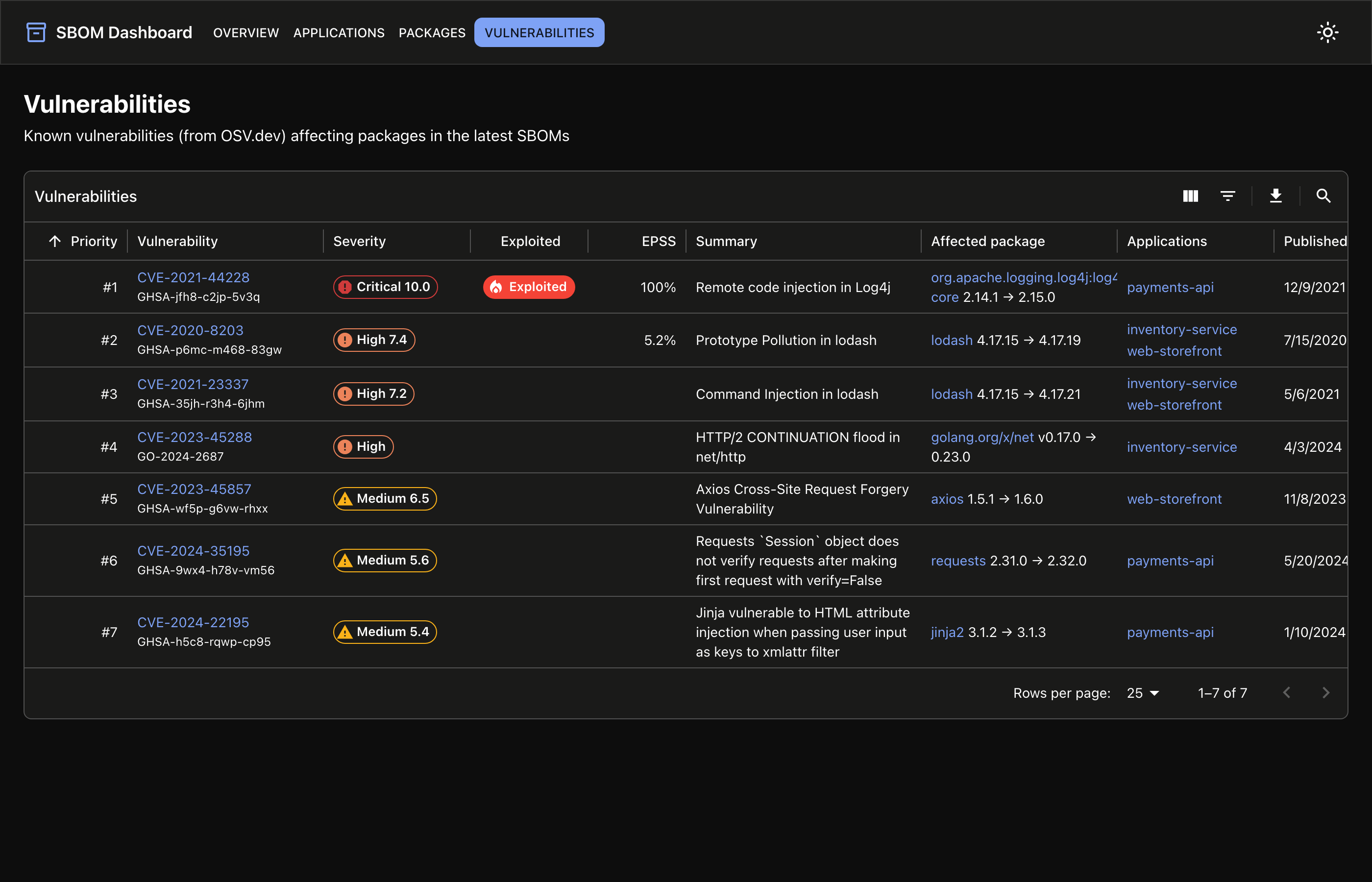
- CISA KEV: vulnerabilities that are known to be exploited in the wild get a chip, a sortable column, and a tile on the overview. If it’s on that list, it jumps the queue.
- EPSS: the estimated probability that a CVE will be exploited in the next 30 days. Useful for breaking ties when nothing is on KEV.
- CVSS: still there, but it’s the last tiebreaker instead of the headline.
The default sort is now KEV, then EPSS, then CVSS, and the overview has a “Fix first” list at the top. Instead of 300 rows, I get a short list I can actually act on.
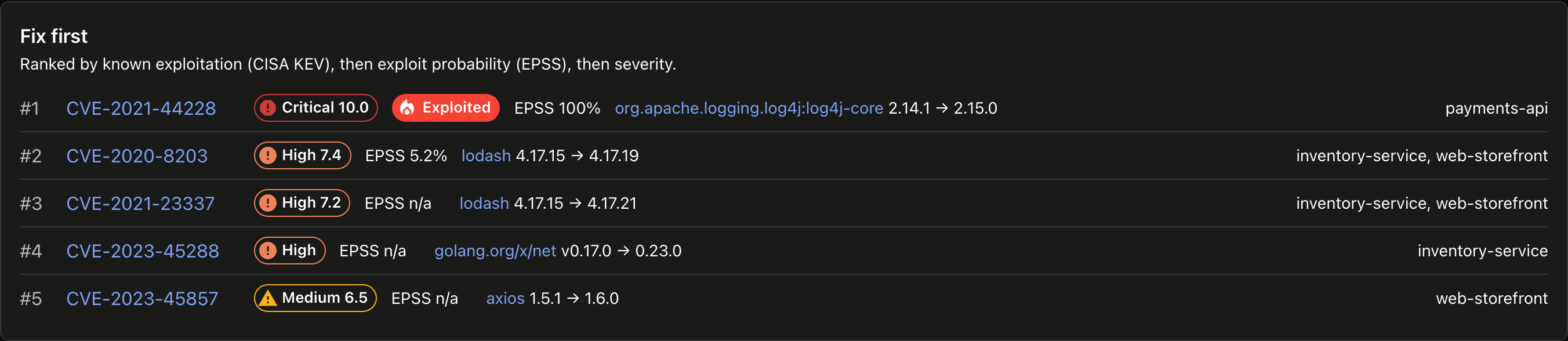
Demo data, not my real applications.
Getting data in
I didn’t want to remember to upload files by hand, so the repo doubles as a GitHub Action. Each of my repos adds a small workflow that generates an SBOM and posts it to the dashboard on every push. For container images, an input runs a Syft scan so OS packages (Alpine in my case) get matched against OSV too.
flowchart LR
  GA[GitHub Action] -->|"POST /api/v1/sboms"| App[Next.js app]
  Browser --> App
  App --> PG[(Postgres)]
  PG -. NOTIFY .-> W[Worker]
  W --> OSV["OSV.dev (CVEs)"]
  W --> DEPS["deps.dev (versions)"]
The app and the worker never talk to each other directly. Instead, the app writes the SBOM
to Postgres and fires a NOTIFY, and a separate Node worker picks it up and does the
enrichment. The worker also re-scans on a schedule, so a CVE published tomorrow shows up
without anyone uploading anything.
Beyond CVEs: is this package even healthy?
A package with zero CVEs today can still be a bad bet. Pulling from deps.dev gave me three more signals:
- Outdated: the latest release, classified as a major, minor, or patch bump.
- Deprecated or abandoned: the registry’s deprecation flag, plus no release in years.
- OpenSSF Scorecard: the score for each package’s source repository.
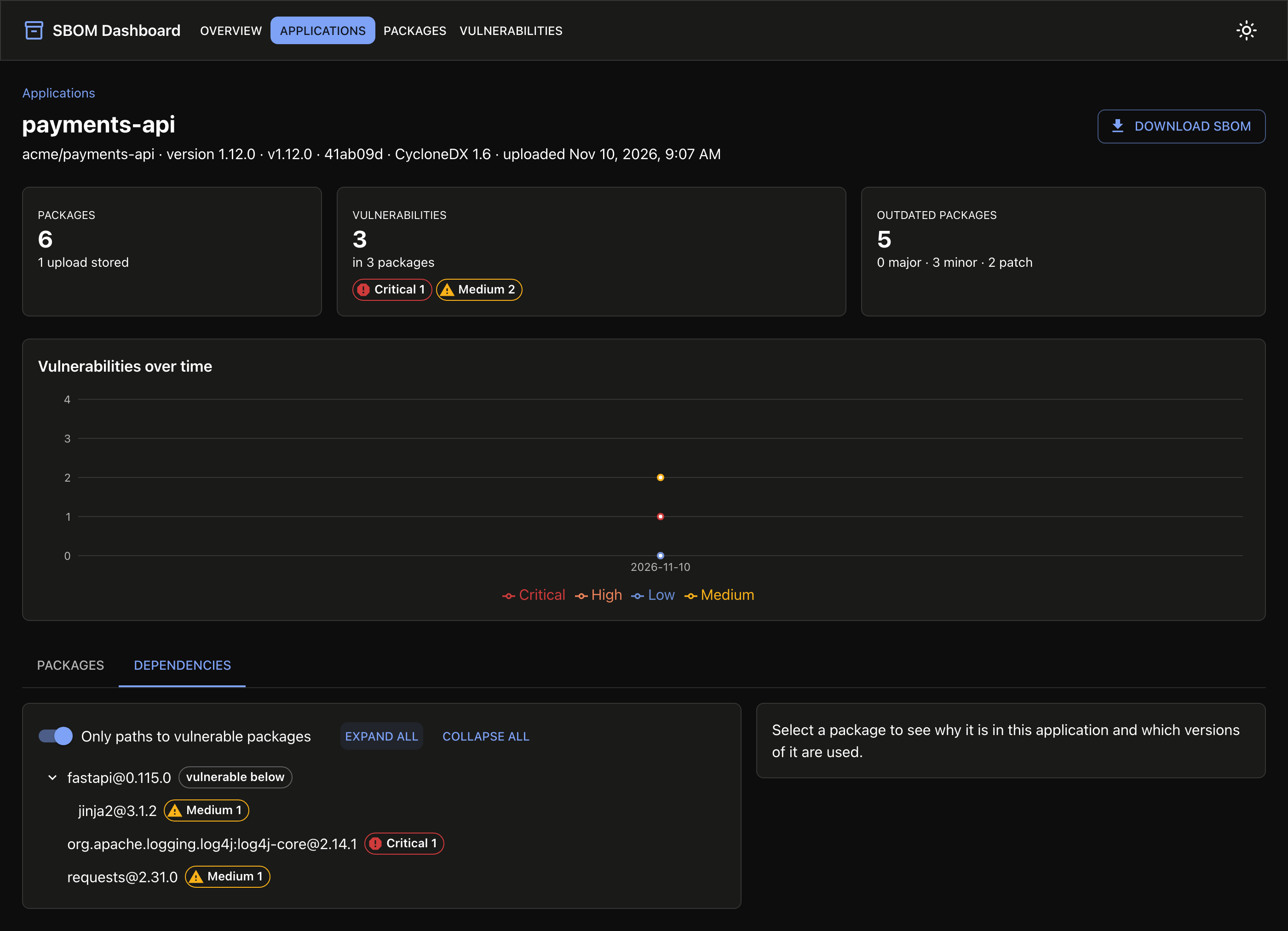
I also store the dependency edges from the SBOM, so for any vulnerable package I can see the path that pulled it in. That answers the question I kept running into: “I never installed that, where did it come from?” Usually it’s a transitive dependency three levels down, and the fix is bumping the one direct dependency above it.
Watching it over time
The worker writes a daily snapshot per project (severity counts, outdated counts, component counts), and there are trend charts on each app and on the overview. A single number is a snapshot of anxiety; a line going down is the thing I actually want to see.
Locking it down
A security tool that is itself sloppy would be embarrassing. It’s single-user, so access is locked to my numeric GitHub ID through GitHub sign-in, and it fails closed in production by default. Everything is gated except the health checks, the sign-in endpoints, and the upload route, which uses its own bearer token. On top of that: a CSP and security headers, a read-only container filesystem with dropped capabilities, and CI checks for the supply chain (zizmor, actionlint, dependency-review, pinned actions, and Trivy scanning the release images). It also runs as a non-root user with a liveness endpoint and graceful worker shutdown, which should make moving it onto my k3s cluster easier.
How I use it
Right now I use it to keep an eye on the dependencies of the applications I have deployed. Each application posts an SBOM through the GitHub Action when I build it, which covers the packages in my own code.
The images are a separate job. My cluster config lives in a GitOps repo, and a weekly workflow there lists every container image the cluster deploys, runs Syft against each one, and uploads the resulting SBOM to the dashboard. A lot of exposure lives in the base image and OS packages rather than in my own code, and this is how it shows up. Because the worker re-scans on a schedule, a CVE published after an image was built still gets flagged.
My routine is low-key: I check in every few days, start with the “Fix first” list, and only dig deeper if something new has landed at the top.
What’s next
Things I’m considering but haven’t built: time-to-fix and SLA tracking, license policy, end-of-life runtimes, base-image age, and Slack or email notifications. I’d also like to write about the other half of this project, which is how I set it up so coding agents can pick the work up across sessions.